
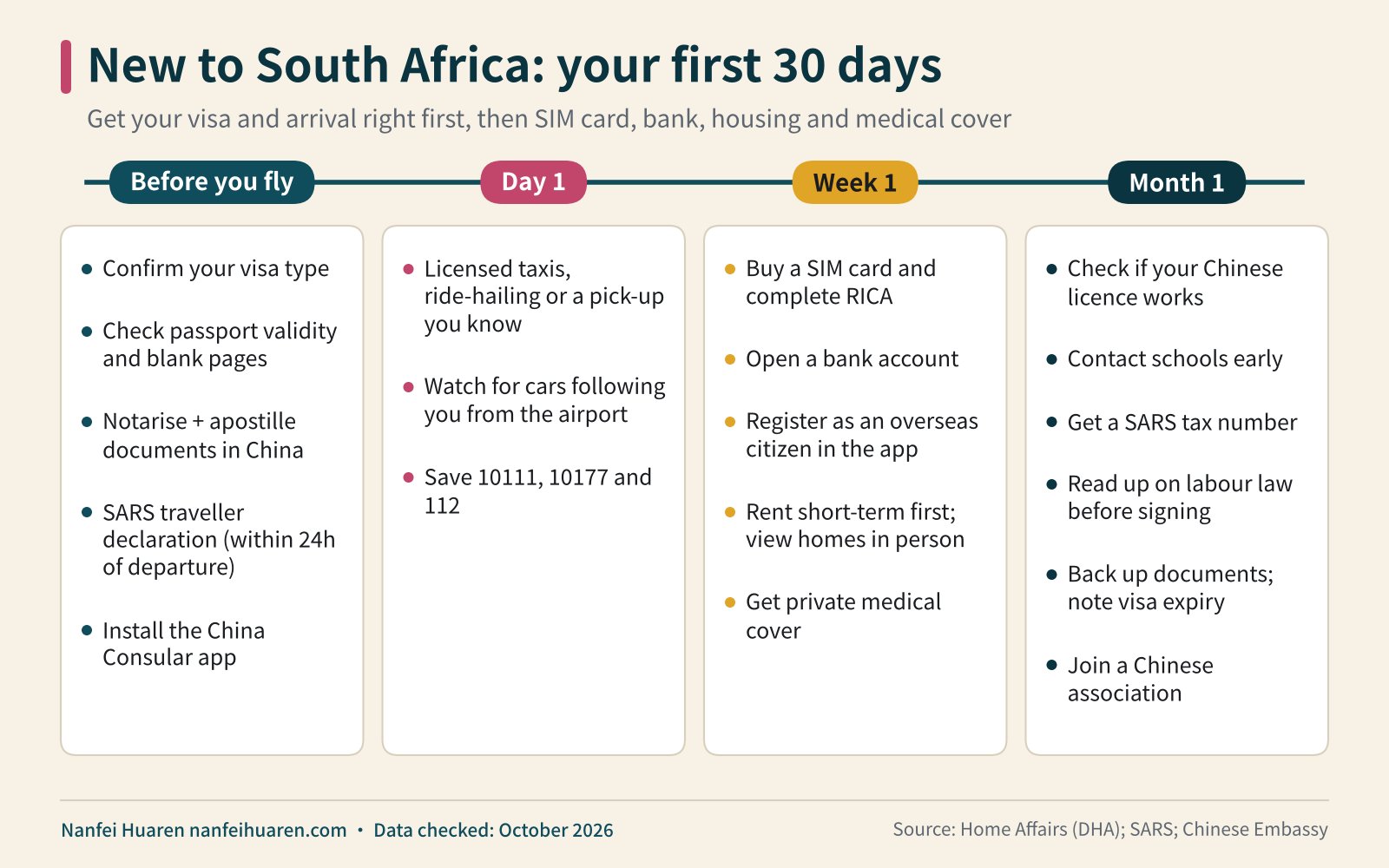
In your first 30 days in South Africa, the priorities are getting your visa paperwork right and arriving safely, then sorting out your SIM card, bank account, housing and medical cover. Here is a checklist in date order; each step links to a full guide.
Before you fly
- Confirm your visa type. Tourist, business, work, study and remote-work visas all have different requirements, so check which one you need first; see the visa section and our work visa guide.
- Check your passport. Make sure it has enough validity left and blank pages. Follow the latest rules from Home Affairs (DHA) and South Africa’s missions in China.
- Prepare your documents. Get degree certificates, police clearance, birth and marriage certificates notarised and translated into English in China. China joined the Apostille Convention on 7 November 2023 and South Africa is also a party, so most documents only need an apostille issued in China, with no consular legalisation.
- Complete the traveller declaration. Since 1 July 2026, everyone entering or leaving South Africa must complete an online traveller declaration with SARS (on the website or app) before travelling; the Chinese Embassy advises doing it within 24 hours of departure. Declare cash and valuables truthfully.
- Install the essential apps. The “中国领事” (China Consular) app, a ride-hailing app, and WhatsApp, which most South Africans use. Don’t carry large amounts of cash; for transfers see sending money between South Africa and China.
Day 1: the airport and getting home
- Outside arrivals, only use licensed taxis, ride-hailing or a driver you arranged. Don’t let strangers help with your bags or change money.
- After leaving the airport, watch for any car following you, and look around before you get out at your gate.
- Save the emergency numbers: police 10111, ambulance 10177, 112 from a mobile, plus your Chinese mission’s consular protection line. See emergency numbers and what to do.
Week 1: phone, bank, registration, housing, medical cover
- Get a SIM card and complete RICA registration. You can buy one at the airport or in a mall; you need your passport and proof of address. See SIM cards and RICA.
- Open a bank account. Foreigners usually need a passport, a valid visa and proof of address, but requirements vary by bank. See our bank account guide.
- Register as a Chinese citizen overseas. Use the “海外公民登记” function in the China Consular app and choose the Embassy or Consulate-General for your area, so you receive safety alerts. The official registration never asks for bank details or money transfers. See Chinese embassy and consulates.
- Find a place to live. Stay somewhere short-term first and view homes in person before signing a long lease. Focus on security, deposit terms and backup power. See our renting guide and load-shedding guide, and the city guides for local differences.
- Get medical cover. Public hospitals have long waits, so most foreigners choose private medical aid. Some visa applications also require proof of medical cover. See medical aid and private hospitals and Chinese-speaking doctors.
Month 1: driving, schools, tax, work
- Driving. Chinese licences are in Chinese. Our driving licence guide explains whether you can use yours, which translation or documents you need, and how to convert it if you stay long term. Without a car, use ride-hailing and the Gautrain; see getting around.
- Schools. Public schools usually open applications for the next school year well in advance, and private and international schools should be contacted early too. See our schools guide.
- Tax number. You need a SARS tax number to work or run a business. Employers usually register their staff, but if you run a business you register yourself. See our income tax guide and company registration.
- Know your rights at work. Read our labour law guide before signing a contract.
- Back up documents and note your visa expiry. Scan your passport, visa page and key documents to cloud storage, put your visa expiry date in your calendar, and start your renewal well ahead of time.
- Join the community. Local Chinese associations and chambers of commerce are a great source of practical tips; see the associations directory.
FAQ
Do I have to register with the Chinese embassy?
It is not compulsory, but we recommend completing the overseas citizen registration in the China Consular app so the mission can send you safety alerts and help you more easily in an emergency.
Do my Chinese documents still need double legalisation?
Since China joined the Apostille Convention on 7 November 2023, South Africa, also a party, generally accepts an apostille. If a particular authority asks for something else, follow its written requirements.
What should I do first after landing?
Get safely to your accommodation, buy a SIM card (with RICA) and save the emergency numbers. Then open a bank account and do the consular registration in your first week.
What do I need to declare when entering?
Since 1 July 2026, you must complete an online traveller declaration with SARS before you travel, and declare cash and goods truthfully.
Sources
- Department of Home Affairs (DHA)
- SARS – Traveller Declaration (online declarations from 1 July 2026)
- 驻南非使馆提醒入出境南非提前完成旅客申报(2026-07-06)
- South African Revenue Service (SARS)
- ICASA – Independent Communications Authority of South Africa
- 中国驻美国使馆:“中国领事”APP“海外公民登记”功能说明(2025-07-15)
- 中华人民共和国驻南非共和国大使馆 / Embassy of the PRC in South Africa
- HCCH – Apostille Convention status table
- Western Cape Government – Know who you can call in an emergency