
Companies in South Africa are registered with the Companies and Intellectual Property Commission (CIPC), and foreigners can own 100% of the shares and serve as directors. A standard private company ((Pty) Ltd) costs about R175 in official fees: R50 to reserve a name plus R125 to register. With complete paperwork the certificate can arrive within a few working days. However, directors with Chinese passports must first pass CIPC’s “foreigner assurance” check and cannot use the BizPortal one-stop service.
Choose the type of business
| Type | Features | Suits |
|---|---|---|
| Private company (Pty) Ltd | Limited liability, so shareholders are not personally liable for company debts; the most common form | Shops, trading and service businesses |
| Sole proprietor | No CIPC registration; unlimited personal liability | Very small one-person businesses |
| External company | A Chinese company registered to do business in South Africa; not a separate legal entity | Parent companies operating directly in South Africa |
| Non-profit company (NPC) | No profit distribution | Associations, chambers, charities |
Most Chinese business owners choose a private company. Note that owning a company does not give you the right to work in South Africa. Directors still need the right visa. See our business visa guide.
Registration steps
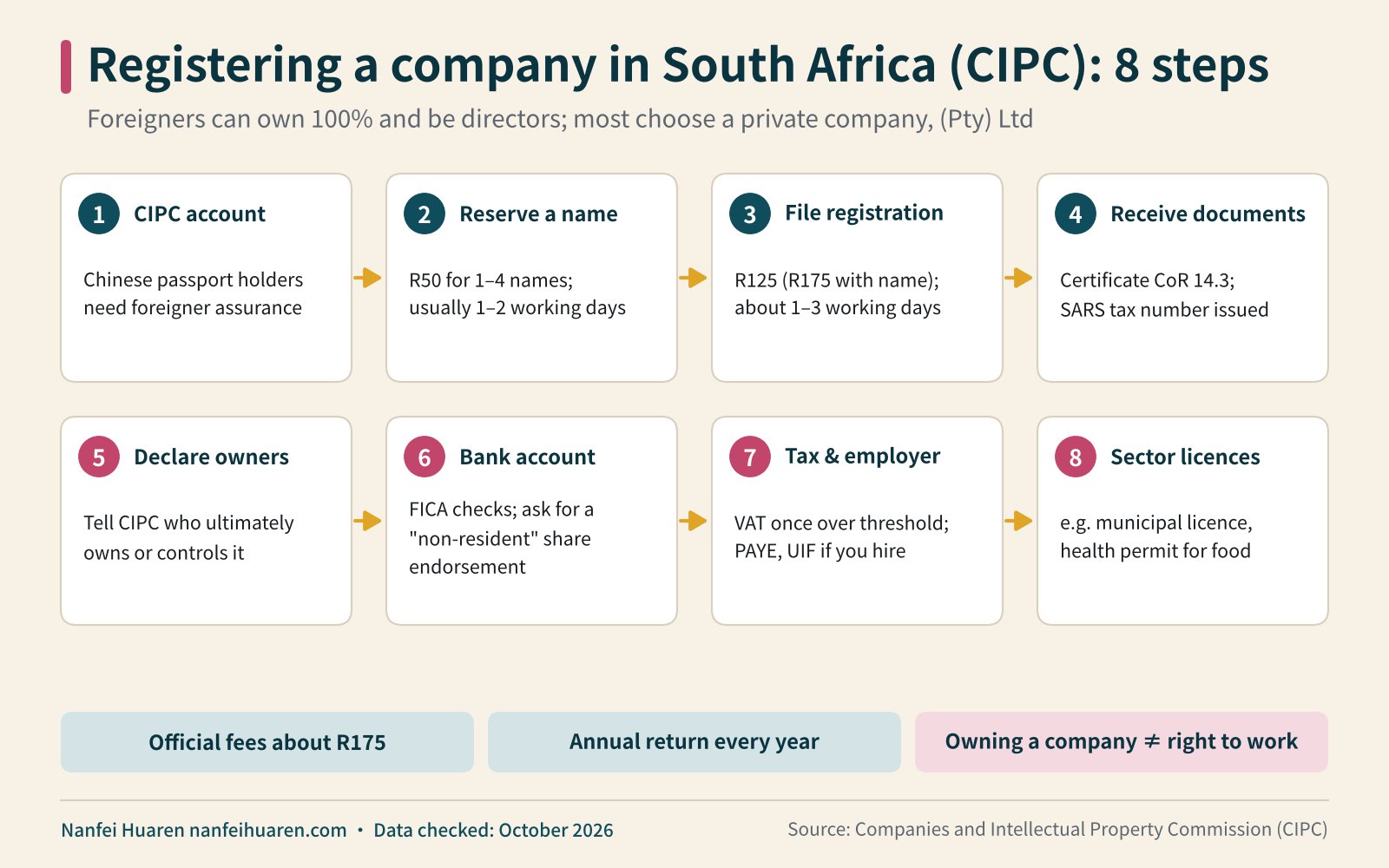
- Register as a CIPC customer: South African ID holders can use BizPortal (bizportal.gov.za). Foreign passport holders must use CIPC e-Services and submit a foreigner assurance application under Notice 64 of 2023, uploading a certified passport copy for manual review. You can only be recorded as a director or beneficial owner once this is approved.
- Reserve a name: you can propose 1–4 names per application for R50, which is non-refundable. Names must not clash with existing companies or trade marks. If all are rejected you pay again. You can also register using the registration number as the name and rename the company later.
- File the registration: enter directors, the registered address and the financial year-end (most choose February to match the South African tax year), using the standard Memorandum of Incorporation (MOI). A private company costs R125, or R175 including the name on BizPortal.
- Receive your documents: CIPC emails the registration certificate (CoR 14.3) and the MOI. The company automatically receives a SARS income tax number.
- File beneficial ownership: every company must tell CIPC which individuals ultimately own or control it. New companies should do this promptly, because annual returns are blocked until it is done.
- Open a business bank account: banks run FICA checks and ask for company documents, directors’ passports, proof of address and the shareholding structure. Foreign shareholders should ask the bank to endorse their share certificates “non-resident”. This makes it easier to send dividends and capital home legally later. See sending money between South Africa and China.
- Tax and employer registrations: appoint the company’s representative taxpayer with SARS. Register for VAT once you pass the threshold (see our VAT guide). If you employ staff, register for PAYE, UIF, Skills Development Levy (SDL) and the Compensation Fund.
- Sector licences: restaurants and food retail need a municipal business licence and health permit. Some imported goods need separate permits.
Fees and timelines (as of October 2026)
| Item | Official fee | Typical time |
|---|---|---|
| Foreigner assurance | — | Depends on CIPC manual review |
| Name reservation | R50 | Usually 1–2 working days |
| Private company registration | R125 (R175 with name) | About 1–3 working days if correct |
| Annual return | Tiered by turnover, from about R100 | Every year in the anniversary month |
Company secretarial firms and accountants charge their own service fees, which vary widely. Ask exactly what is included before you sign.
Staying compliant after registration
- CIPC annual return: file every year in the anniversary month and keep beneficial ownership up to date. Companies that stop filing are deregistered, and their bank accounts can be frozen.
- Corporate income tax: 27%, with an annual return and provisional tax payments where required.
- Records: keep books, invoices and bank statements, and prepare financial statements as the MOI and the Companies Act require.
- B-BBEE: businesses with turnover under R10 million can confirm their level with a sworn affidavit. See our B-BBEE guide.
Common mistakes
- Registering the business in a local person’s name as a nominee: this is very risky for your assets. Adding token black shareholders to boost B-BBEE can also amount to fronting, which is a criminal offence.
- Registering and then never filing annual returns: after a few years the company is deregistered and its bank account frozen.
- Skipping outbound investment formalities in China: Chinese companies and individuals investing in South Africa may need to file or register the investment with Chinese commerce, development and foreign-exchange authorities. Check with your local authorities before you invest.
- Passport details entered incorrectly: director details must match the passport used for foreigner assurance exactly.
More in our Business section.
FAQ
Can a foreigner own 100% of a South African company?
In most sectors, yes. There is no general cap on foreign ownership. Regulated sectors such as mining, telecoms and private security have extra rules, and government customers will look at your B-BBEE level.
Do directors have to live in South Africa?
The Companies Act does not require directors of a private company to be resident. In practice, a director or representative based in South Africa makes banking and tax administration much easier.
Can I register from China?
CIPC e-Services works online, and foreigner assurance is also submitted online with certified documents. Opening the business bank account, however, usually requires the director in person or another form of identity check the bank accepts.
Do I have to register for VAT straight away?
Not necessarily. VAT registration is compulsory once taxable turnover exceeds R2.3 million in 12 months. Below that you may register voluntarily once turnover exceeds R120,000.