The legal way to send money from South Africa to China is through a bank or a SARB-authorised foreign exchange dealer, with proof of where the money came from. Chinese nationals working in South Africa on a temporary visa can generally transfer money they earned lawfully here, in amounts that match their income. The R2 million single discretionary allowance (SDA) is mainly for South African residents; do not assume it applies to you as a foreigner.
How South African exchange control works
South Africa still has exchange controls. They are run by the Financial Surveillance Department of the South African Reserve Bank (SARB) and applied day to day by banks (Authorised Dealers) and Authorised Dealers in foreign exchange with Limited Authority (ADLAs). Every cross-border payment needs a reason (a balance of payments category), and large or unusual transfers will need supporting documents.
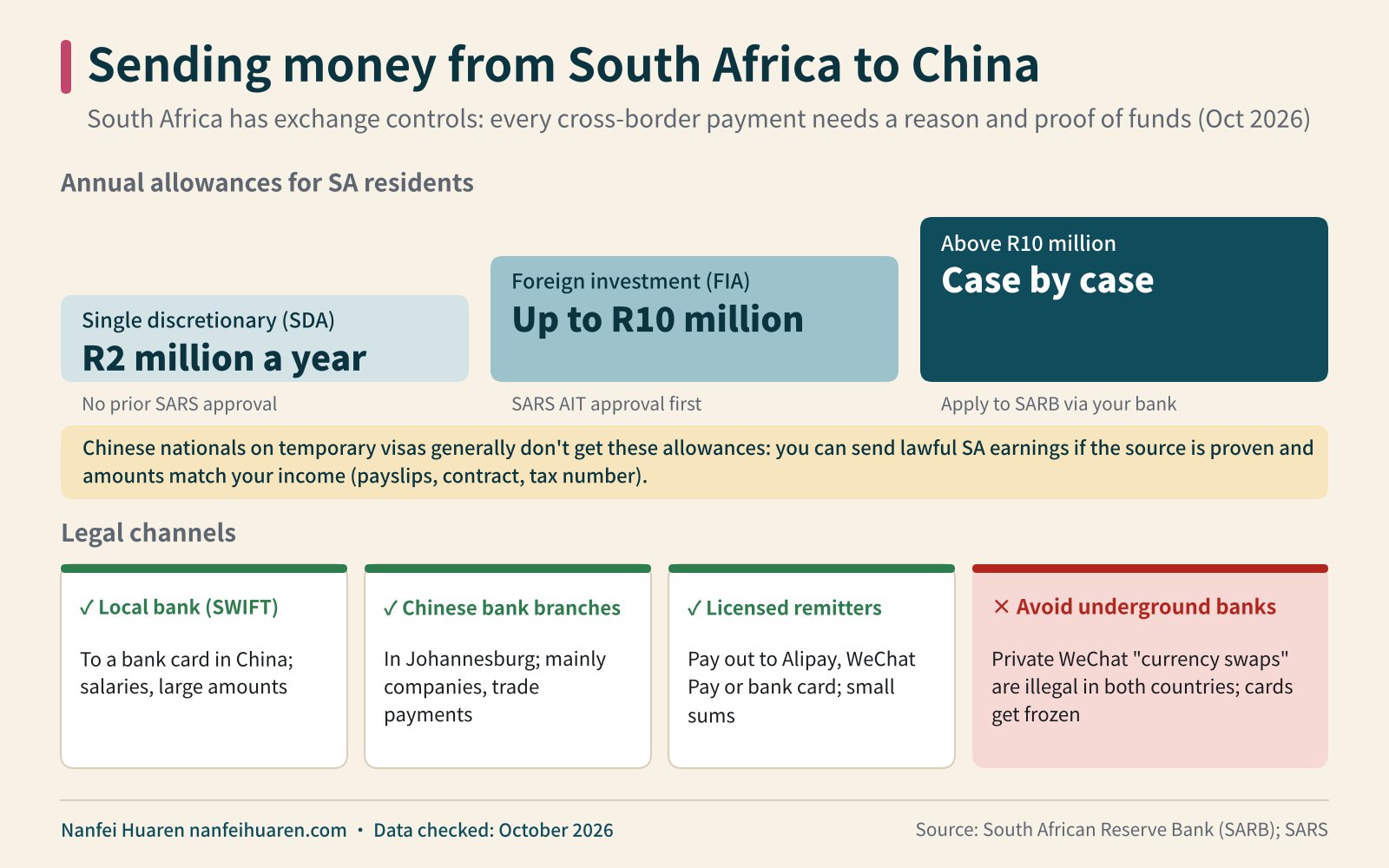
The main allowances as of October 2026 (for South African residents aged 18 and over):
| Allowance | Limit | Condition |
|---|---|---|
| Single discretionary allowance (SDA) | R2 million per calendar year (raised from R1 million in 2026) | No prior SARS approval |
| Foreign investment allowance (FIA) | Up to R10 million per year | SARS Approval for International Transfer (AIT) first |
| Above R10 million | Case-by-case | Application to SARB via your bank |
Chinese nationals on temporary visas: what can you send?
Under SARB’s guidelines for individuals, foreign nationals temporarily resident in South Africa (on work, business and similar visas, not holiday or business visitors) may:
- declare their foreign assets in writing to their bank and undertake not to make them available to South African residents; after that they may bank on a resident basis;
- transfer abroad funds accumulated during their stay, if they can show the source and the amount is reasonable compared with their income here;
- transfer back capital they brought in, if they can prove it was introduced from abroad.
Those guidelines do not give temporary residents an SDA or foreign investment allowance. In practice banks usually ask for payslips, an employment contract, a SARS tax number or tax certificate (such as an IRP5). Since late 2025 banks have also tightened rules for sending South African-source income (dividends, rent, profits) to non-residents, requiring SARS tax compliance approval. Register and file with SARS first: see South African income tax and tax residence.
Permanent residents are generally treated as South African residents and can use the SDA and FIA above. Your bank makes the final call on your status.
Legal channels compared
| Channel | Paid out to | Best for | Watch out for |
|---|---|---|---|
| Local bank SWIFT transfer: Standard Bank, FNB, Absa, Nedbank, Capitec and others | Bank account in China | Salaries, large amounts, business | International payments must be enabled; fees and exchange margins differ |
| Chinese bank branches in Johannesburg (Bank of China, CCB, Bank of Communications) | Account in China | Trade settlement, companies | Mainly corporate clients; ask about personal service |
| Licensed remittance companies (e.g. Mukuru) | Alipay, WeChat Pay, bank card | Small, regular family transfers | Foreign ID limits linked to monthly income; proof of income needed |
| International money transfer (e.g. Western Union) | Cash or account | Urgent, small amounts | Check local agents and payout options first |
Mukuru, for example, pays into the recipient’s Alipay wallet, WeChat Pay or bank card. Customers with foreign ID can send up to about 12 times their monthly income, with proof of income. Check its website for current fees and rates.
To enable international payments on your account, see Opening a bank account in South Africa. Import and export payments should go through a business account with invoices and customs documents: see Importing and exporting between China and South Africa.
On the China side
- USD 50,000 per person per year: this is the convenience quota for converting foreign currency into RMB; above it, banks ask for proof of the transaction’s genuineness.
- From 1 January 2026 China requires stronger identity checks on outbound transfers above RMB 5,000 or USD 1,000, with stricter anti-money-laundering rules, so family members sending money out of China face more questions.
- Do not split one transfer across many relatives’ accounts. This “structuring” can be treated as evading foreign exchange rules.
Stay away from underground money exchangers
Informal WeChat “currency swaps” are common: you hand over rand in South Africa and someone pays you RMB in China. These underground banks (地下钱庄) are illegal in both China and South Africa:
- in China, dealing in foreign exchange illegally can be prosecuted as an illegal business operation, and receiving bank cards are often frozen by police, even if you were “only receiving”;
- in South Africa, moving money across borders outside authorised dealers breaches exchange control and may count as money laundering;
- operators disappear with funds or pay you with scam proceeds, and you rarely get money back.
If you are defrauded, the Chinese embassy and consulates can advise: see Chinese embassy and consulates in South Africa.
Also note: from 2026 you may take up to R100,000 in rand banknotes out of South Africa per person (up from R25,000), and large amounts of foreign cash must be declared to customs in both South Africa and China. Gambling winnings also need a clear paper trail: only licensed sports betting, land-based casinos and similar are legal in South Africa, and online casino games are illegal; money moving to or from such sites is quickly flagged by banks. See our gambling section.
FAQ
Can I send my salary home every month?
Yes. Keep payslips, your contract and your SARS tax number ready; banks generally process this as transferring lawful earnings, as long as amounts match your income.
Can foreigners use the R2 million SDA?
The SDA is designed for South African residents. Temporary residents mainly transfer on the “proven source, reasonable amount” basis; whether you can use the SDA is up to your bank.
My family is sending money from China to buy a home here. What should we keep?
Use a bank transfer and keep the transfer confirmation and the bank’s inflow record (deal receipt). You will need them to send the sale proceeds back later.
Can money from South Africa arrive in Alipay or WeChat?
Yes, through licensed providers such as Mukuru that pay out to Alipay and WeChat Pay. Private WeChat swaps are not a legal channel.
More in our banking section.
Sources
- South African Reserve Bank: Currency and Exchanges Guidelines for Individuals
- Moonstone: SARB finalises Budget-linked exchange control reforms
- Polity: SDA and AIT rules
- Sovereign Group: Budget 2026 takeaways
- Mondaq: SARS compliance required for non-resident income remittances
- Mukuru: Send money from South Africa to China
- Sinoblawg: China tightens foreign exchange control from 1 January 2026