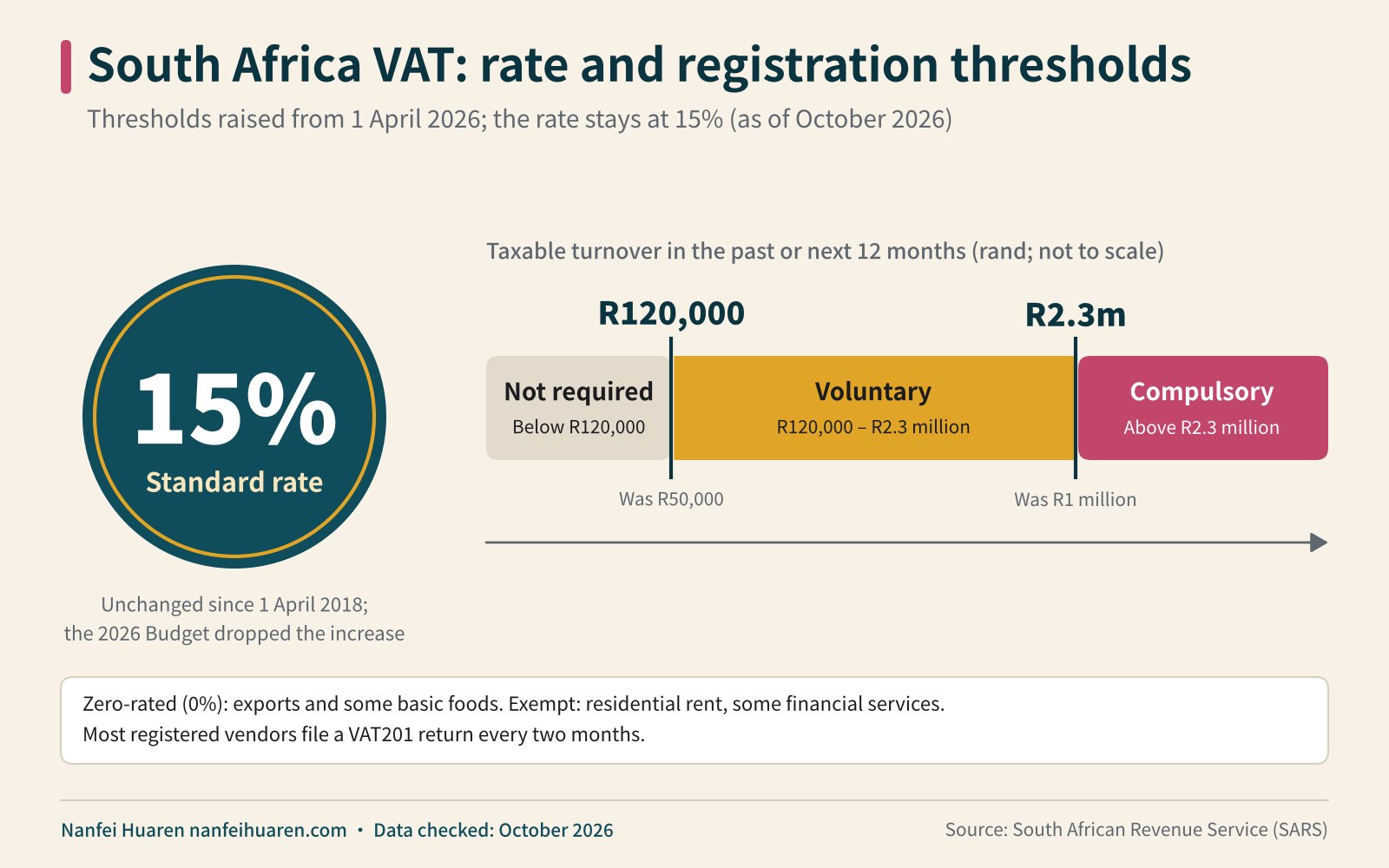
As of October 2026 the standard VAT rate in South Africa is still 15%, and the 2026 Budget did not raise it. From 1 April 2026, businesses must register for VAT once taxable turnover exceeds R2.3 million in 12 months (previously R1 million), and may register voluntarily above R120,000 (previously R50,000). Most registered vendors file a VAT201 return on SARS eFiling every two months.
The rate: still 15%
A VAT increase proposed in the 2025 Budget was later withdrawn. On 25 February 2026, Finance Minister Enoch Godongwana formally dropped the planned increase in the 2026 Budget, so the standard rate stays at 15%, where it has been since 1 April 2018. Supplies fall into three groups:
| Type | Rate | Examples |
|---|---|---|
| Standard-rated | 15% | Most goods and services |
| Zero-rated | 0% (input tax claimable) | Exports; some basic foods such as brown bread, maize meal, rice, eggs, fresh fruit and vegetables |
| Exempt | No VAT (input tax not claimable) | Residential rent, some financial services, public road and rail passenger transport |
Registration thresholds (from 1 April 2026)
| Situation | Old threshold | New threshold |
|---|---|---|
| Compulsory: taxable turnover in the past or next 12 months exceeds | R1 million | R2.3 million |
| Voluntary: taxable turnover in the past 12 months exceeds | R50,000 | R120,000 |
Points to note:
- SARS says the amending legislation has not yet been promulgated, but it is already applying the new thresholds to new applications.
- If you registered voluntarily and your turnover over the past 12 months is below R120,000, SARS will notify you that it intends to cancel your registration. Between R120,000 and R2.3 million you may apply to deregister, but you will not be deregistered automatically.
- On deregistration, stock and assets you still hold can be treated as a deemed supply and taxed. Speak to an accountant first.
- Micro businesses with turnover below R2.3 million can also consider the simplified turnover tax system.
Should you register voluntarily?
If most of your customers are VAT-registered businesses (for example, you wholesale to shops), registering usually pays off. They can claim the VAT you charge, and you can claim the VAT on your purchases and imports. If you run a retail shop selling to the public, your prices must include 15% VAT once you register, which can hurt your competitiveness. Registration also means a return every period and stricter record-keeping.
How to register
- Get a tax number first: a company gets an income tax number automatically when it is registered. See registering a company.
- Prepare documents: company registration documents; the public officer’s ID and proof of residential address (less than 3 months old); proof of business address (less than 3 months old); the last 3 months of the business’s own bank statements; the resolution appointing the public officer; and proof of turnover, such as sales invoices or contracts.
- Apply on eFiling: SARS now requires online applications. Book a branch appointment only if you cannot apply online.
- Cooperate with verification: to fight VAT fraud, SARS may ask for more documents or inspect your business premises. Both the business and the public officer must be tax compliant, or the application will be refused.
Online applications usually take 21 working days. Chinese documents need a formal English translation.
Filing and paying
- Tax periods: most vendors file every two months. Vendors with taxable turnover above R30 million a year file monthly, and a few categories file every six months or annually.
- Deadlines: eFilers generally file and pay by the last business day of the month after the tax period ends. The 2026 Budget proposes removing the different deadlines for electronic and manual filers, so that everyone files by the last business day of the month.
- Penalties: late payment triggers penalties and interest. Persistent non-filing damages your tax compliance status, which then affects tenders, transfers abroad and visa renewals.
Invoices and import VAT
Once registered, your tax invoices must show the words “Tax Invoice”, your VAT number, the customer’s details (for larger amounts), a description of the goods, the amount and the VAT. You also need valid invoices to claim input tax. Import VAT paid on goods from China can be claimed with the customs release documents. For how it is calculated, see importing from China.
Common mistakes by Chinese-owned businesses
- Charging 15% VAT on invoices without being registered: this is unlawful.
- Leaving cash sales off the books: SARS cross-checks bank statements, import data and POS records.
- Claiming input tax on invoices with no VAT number or missing details: these claims are reversed on audit.
- Mixing personal and business bank accounts: this causes problems at registration and on audit.
For personal tax, see our personal income tax guide, and more in our Tax section.
FAQ
Did VAT go up in 2026?
No. The 2026 Budget formally dropped the increase, and the rate is still 15% as of October 2026.
My turnover has just passed R2.3 million. How quickly must I register?
Once you exceed, or expect to exceed, the threshold, apply to SARS within 21 business days. If you register late, SARS can backdate the registration and claim the VAT you should have charged.
Does a foreign company selling in South Africa need to register?
Yes, if it carries on business in South Africa and passes the threshold. Separate rules apply to foreign suppliers of electronic services to South African customers.
Can I file VAT returns myself?
Yes, on eFiling. At least at the start, though, it is worth having a registered tax practitioner or accountant set up your bookkeeping.