
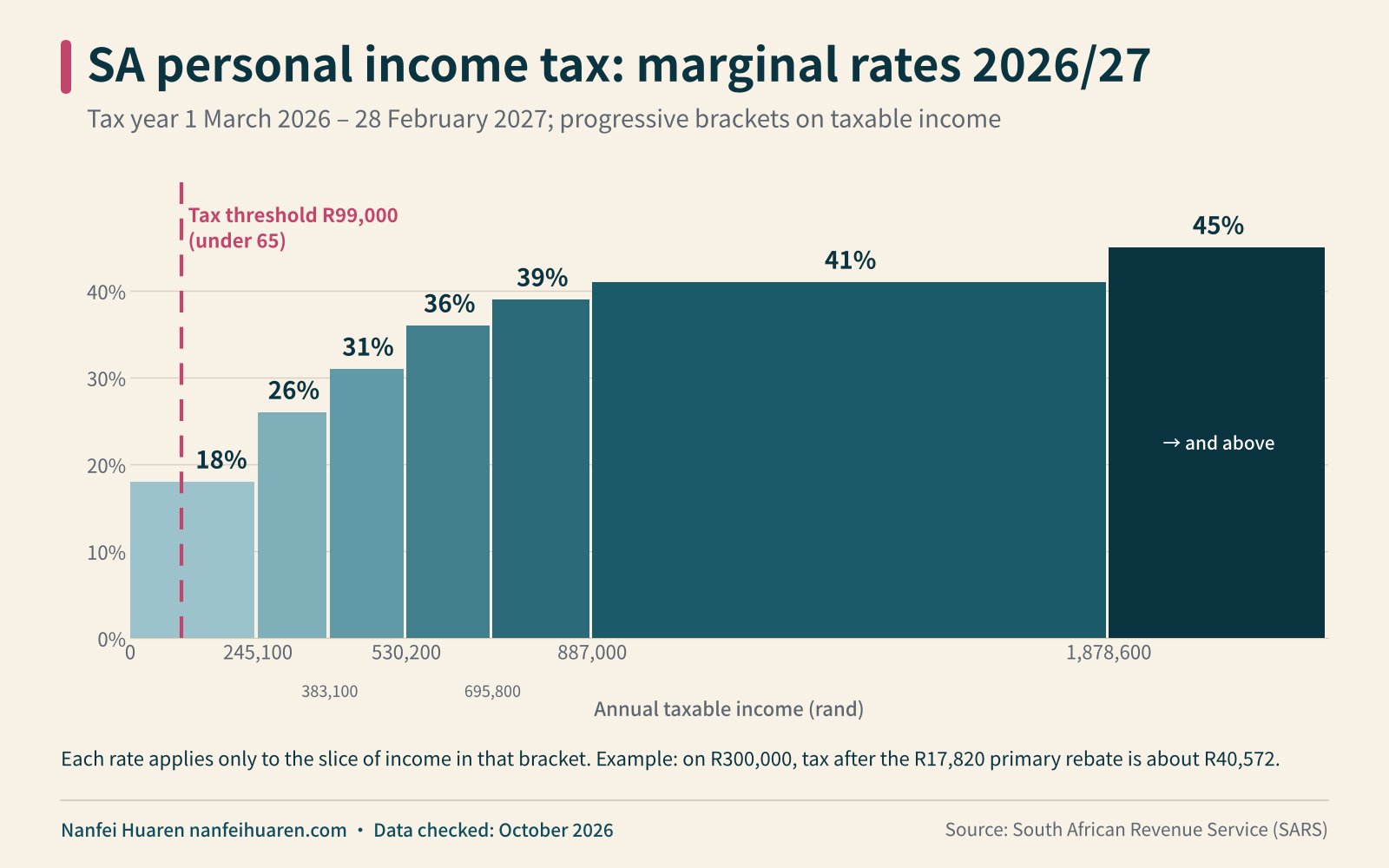
South Africa taxes on the basis of residence. Tax residents declare their worldwide income to the South African Revenue Service (SARS), while non-residents pay tax only on South African-source income. There are two residency tests: “ordinarily resident” and “physical presence”. As of October 2026, for the 2026/27 tax year (1 March 2026 to 28 February 2027) people under 65 pay no tax on taxable income below R99,000, and the top marginal rate is 45%. China and South Africa have a tax treaty that prevents the same income being taxed twice.
Step 1: are you a South African tax resident?
1. Ordinarily resident
This test asks where your “real home” is: where your family, home, work and daily life are centred, and whether you intend to return after you travel. People with permanent residence who have settled here with their family usually fall into this category. There is no fixed day count. SARS looks at the whole picture.
2. Physical presence test
If you are not ordinarily resident, you are resident for a tax year if you meet all three of these conditions:
- more than 91 days in South Africa in the current tax year;
- more than 91 days in each of the five previous tax years;
- more than 915 days in total over those five years.
Any part of a day in South Africa counts as a day. If you are resident under this test and then stay outside South Africa for at least 330 full consecutive days, you are treated as non-resident from the day you left. Keep your passport stamps and tickets so you can count your days.
Resident in both China and South Africa?
China also taxes its residents on worldwide income. If both countries treat you as resident, the tie-breaker rules in the China–South Africa treaty decide which one counts. They look in turn at your permanent home, your centre of vital interests, your habitual abode and your nationality. If that still does not settle it, the two tax authorities agree between them.
2026/27 income tax tables
| Taxable income (R) | Tax |
|---|---|
| 1 – 245,100 | 18% |
| 245,101 – 383,100 | 44,118 + 26% of the amount above 245,100 |
| 383,101 – 530,200 | 79,998 + 31% of the amount above 383,100 |
| 530,201 – 695,800 | 125,599 + 36% of the amount above 530,200 |
| 695,801 – 887,000 | 185,215 + 39% of the amount above 695,800 |
| 887,001 – 1,878,600 | 259,783 + 41% of the amount above 887,000 |
| 1,878,601 and above | 666,339 + 45% of the amount above 1,878,600 |
Rebates are then deducted from the tax: a primary rebate of R17,820, plus R9,765 if you are 65 or older and a further R3,249 from 75. The resulting tax thresholds are R99,000 (under 65), R153,250 (65 and older) and R171,300 (75 and older). Medical aid members also get a medical scheme fees tax credit. For 2026/27 it is R376 a month each for the taxpayer and the first dependant, and R254 a month for each additional dependant. See choosing medical aid.
Example: on taxable income of R300,000, tax is 44,118 + (300,000 − 245,100) × 26% = R58,392. After the R17,820 primary rebate, the tax for the year is about R40,572, or roughly R3,381 a month.
Paying and filing
- Employment income: your employer deducts PAYE every month and gives you an IRP5 certificate after the year ends.
- Tax number: you or your employer registers you on SARS eFiling when you start work. Foreigners register with a passport and may need to visit a SARS branch to verify their identity.
- Annual return: in the 2026 filing season (for the tax year that ended in February 2026), the deadline for non-provisional taxpayers is 23 October 2026, and for provisional taxpayers 22 January 2027. If you received an auto-assessment and agree with it, you do not need to file.
- Provisional taxpayers: if you have non-salary income such as a business, rent or investments, you pay provisional tax in two instalments a year.
The China–South Africa tax treaty
The treaty was signed in Pretoria on 25 April 2000 and entered into force on 7 January 2001. It applies to income from 1 January 2002. The main withholding tax caps are:
| Income | Treaty cap |
|---|---|
| Dividends | 5% |
| Interest | 10% |
| Royalties | 10% (effectively about 7% for equipment royalties) |
To claim treaty rates you usually give the payer a declaration and proof of residence. South African residents can generally claim a credit in South Africa for tax paid in China, and the reverse also applies.
Common mistakes
- Thinking a work visa means you are not resident: tax residency does not depend on your visa. It depends on where you live and how many days you spend here.
- Not declaring rent or interest earned in China: South African residents must declare worldwide income, and both countries exchange financial account information under the CRS.
- Sending large sums home without sorting out tax compliance first: large transfers may need a SARS Tax Compliance Status (TCS). See sending money between South Africa and China.
- Running a business but declaring only a salary: business income must also be declared. For VAT, see our VAT guide.
More in our Tax section.
FAQ
When is the South African tax year?
From 1 March to the last day of February the next year. SARS calls 2026/27 the “2027 year of assessment”.
Do I need to file if I earn little?
According to reports on the 2026 filing season, people who earned less than R500,000 from a single employer and had no other income generally do not need to file. Check the criteria SARS publishes each year.
I’ve moved back to China. Do I still pay tax in South Africa?
Once you are non-resident, you only pay tax on South African-source income, such as rent from property here. Before leaving, update your residency status with SARS and sort out retirement funds and accounts.
Does this affect my tax in China?
It can. Chinese tax residents must also declare foreign income and can claim a credit for South African tax paid. Ask the Chinese tax authorities or a qualified adviser.