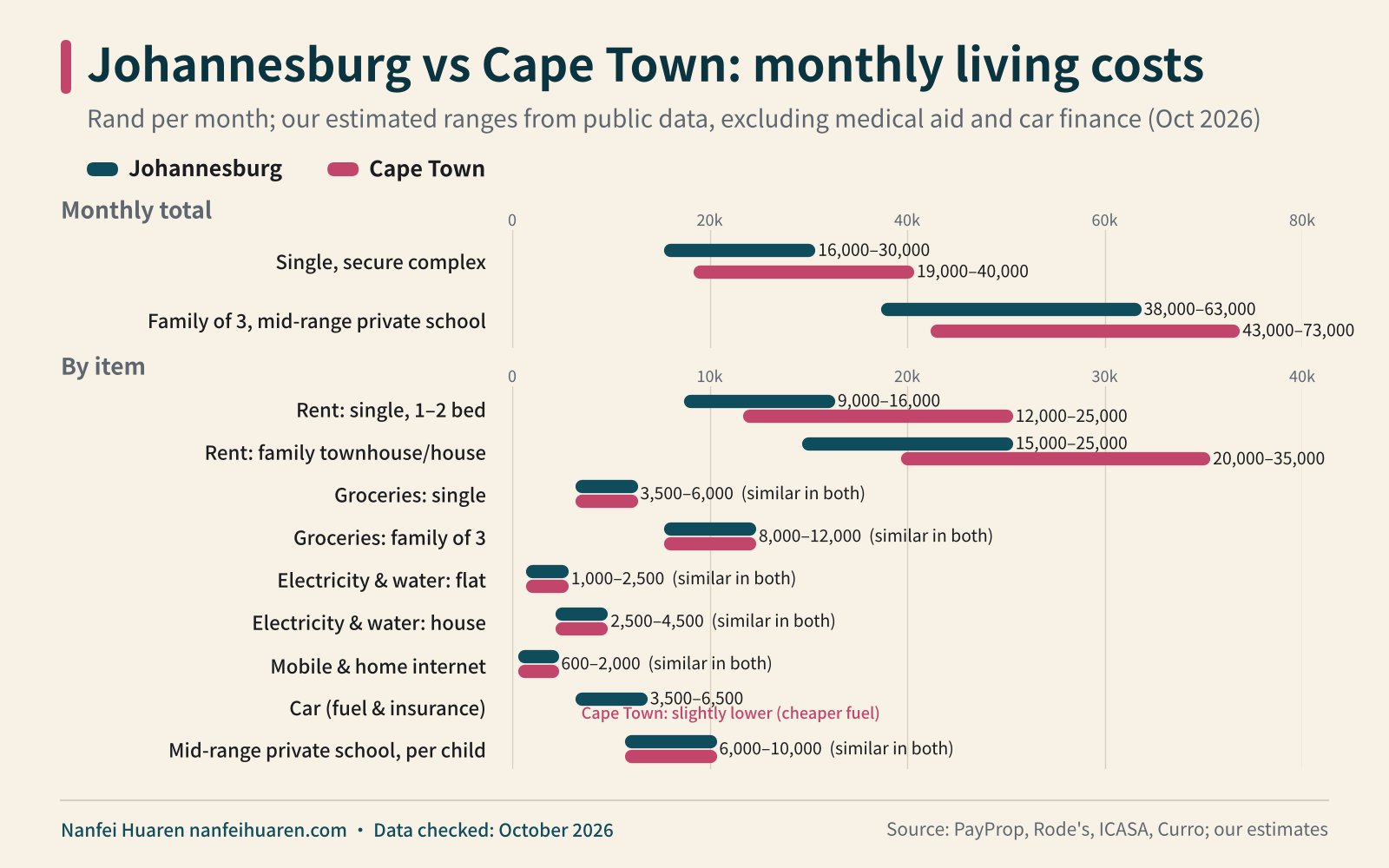
As a rough guide (as of October 2026), a single person living in a secure complex in Johannesburg spends about R16,000–R30,000 a month; in Cape Town, where rent is higher, about R19,000–R40,000. A family of three with one child at a mid-range private school spends about R38,000–R63,000 a month in Johannesburg and R43,000–R73,000 in Cape Town. These exclude medical aid and car finance. They are our own ranges built from the public data below, and real budgets vary widely.
Monthly costs compared
| Item | Johannesburg | Cape Town | Basis |
|---|---|---|---|
| Rent (single, 1–2 bed in a secure complex) | About R9,000–R16,000 | About R12,000–R25,000 | PayProp, Rode’s |
| Rent (family townhouse or house) | About R15,000–R25,000 | About R20,000–R35,000 | As above, estimate |
| Groceries and household (single / family of three) | R3,500–R6,000 / R8,000–R12,000 | Similar | Estimate |
| Electricity and water (flat / house) | R1,000–R2,500 / R2,500–R4,500 | Similar | Estimate |
| Mobile and home internet | R600–R2,000 | Similar | ICASA |
| Car (fuel and insurance, no finance) | About R3,500–R6,500 | Slightly lower (cheaper fuel) | Fuel price, estimate |
| Mid-range private school (per child) | About R6,000–R10,000 | About R6,000–R10,000 | Curro fee letter |
At roughly R2.3 to one yuan, R25,000 a month is about 11,000 RMB. The rand moves a lot, so leave a margin in your budget.
Rent: the biggest cost
According to the PayProp Rental Index, the national average rent in Q1 2026 was R9,582. Gauteng averaged about R9,600 and the Western Cape R12,125, the highest of any province and up 7.4% year on year. Chinese residents usually choose better-secured complexes, so real rents are above average. In Rode’s Report (Q1 2024), upmarket two-bedroom flats in Cape Town cost about R24,000 in the City Centre, R35,000 around Sea Point and R14,000 in Rondebosch and Claremont. In Johannesburg areas popular with Chinese residents, such as Sandton, Rosebank and Bedfordview, a two-bedroom unit in a secure complex is usually above R10,000. See our renting guide.
Groceries and household
At supermarkets such as Checkers, Pick n Pay and Woolworths, meat and fruit are cheaper than in China, while imported Chinese ingredients cost more. For reference, the basic food basket tracked by the PMBEJD for a low-income household of seven averaged R5,479.80 nationally in August 2026. Chinese families often buy sauces and vegetables at Chinese supermarkets; see our Chinese supermarkets guide.
School fees
Public school fees vary widely, and good public schools can charge substantial fees. As a mid-range private example, Curro Century City charges R8,300 a month for Grade 8 in 2026 (R99,600 a year) and R9,950 a month for Grade 12, plus a R5,250 enrolment fee, uniforms and stationery. The most expensive private day schools charge about R140,000–R275,000 a year in 2026, and top boarding schools over R450,000. See how to choose a school.
Car, phone and utilities
- Fuel: from 7 October 2026, 95 petrol costs R30.25 a litre in Gauteng and R29.38 at the coast, a record high. Driving 1,000 km a month at 8 litres per 100 km costs about R2,400 in fuel.
- Phone: a prepaid bundle of around 1GB costs about R79–R95 (ICASA, March 2026).
- Electricity: City Power in Johannesburg raised tariffs by 8.63% from 1 July 2026, and some customers also pay a R70 monthly service charge and a R140 network capacity charge. Cape Town and other metros also raised tariffs in July. For backup power costs see load-shedding and water outages.
- Security: alarm monitoring and armed response are monthly costs, especially for a freestanding house.
Medical aid
Public healthcare is stretched, so most Chinese residents buy private medical aid. Premiums vary widely by plan, age and family size and are a major budget item; see choosing medical aid.
Ways to save
- Rent short-term for a month or two before signing a lease, and check commute and security in person.
- Live close to work; with fuel this expensive, commuting costs add up quickly.
- Install fibre at home and avoid out-of-bundle mobile data.
- Buy in bulk at wholesalers such as Makro and share orders of Chinese groceries with friends.
FAQ
Is Johannesburg or Cape Town more expensive?
Mainly rent: average rents in Cape Town are clearly higher than in Gauteng. Other costs are similar, and fuel is slightly cheaper at the coast.
What income do I need to live comfortably?
A single person in Johannesburg is usually comfortable on R25,000 or more after tax; a family paying private school fees needs considerably more. Remember to factor in income tax.
How often do these numbers change?
Fuel prices change monthly, electricity and water tariffs every July, school fees every January and rent at each lease renewal. Re-check your budget every year.
More in our Living section.
Sources
- ICASA: Bi-Annual Tariff Analysis Report, 2025/26 FY Q4 (March 2026)
- PayProp: Rental growth rebounds in Q1 2026, but not everywhere (30 Jul 2026)
- The Citizen: Average rent in Western Cape reaches R12k (PayProp Q1 2026, 3 Aug 2026)
- BusinessTech: Suburbs with the most expensive rent (Rode’s Report Q1 2024)
- Business Day: Food affordability squeeze despite August price dip (PMBEJD, 26 Aug 2026)
- Curro Century City: 2026 high school fee letter
- BusinessTech: Most expensive private schools in South Africa in 2026
- TimesLIVE: Record fuel price hikes – what you’ll pay from 7 October 2026
- Business Day: Joburg 8.63% electricity tariff hike from 1 July 2026