
To work legally in South Africa, a Chinese citizen must hold a work visa before entering. Since October 2024 the critical skills work visa and the general work visa use a points-based system: you need 100 points, and an occupation on the critical skills list scores 100 on its own. As of October 2026 the government work visa fee is R1,520, and applications lodged at a visa centre in China usually take about eight weeks.
Types of work visa
| Type | Who it suits | Maximum term |
|---|---|---|
| Critical skills work visa | Engineers, IT, health and other professionals whose occupation is on the critical skills list | Up to 5 years |
| General work visa | People with a South African job offer whose occupation is not on the list | Contract period, up to 5 years |
| Intra-company transfer (ICT) visa | Staff seconded from a Chinese parent company to a South African branch or subsidiary | Up to 4 years, not renewable |
| Corporate visa | Companies hiring a number of foreign workers (for example on a project) | Up to 3 years |
Chinese companies often use the ICT visa for seconded staff. It requires an employment contract of at least six months with the foreign company and a skills transfer plan. The ICT visa cannot be renewed, so plan ahead for long projects.
The points system: reaching 100
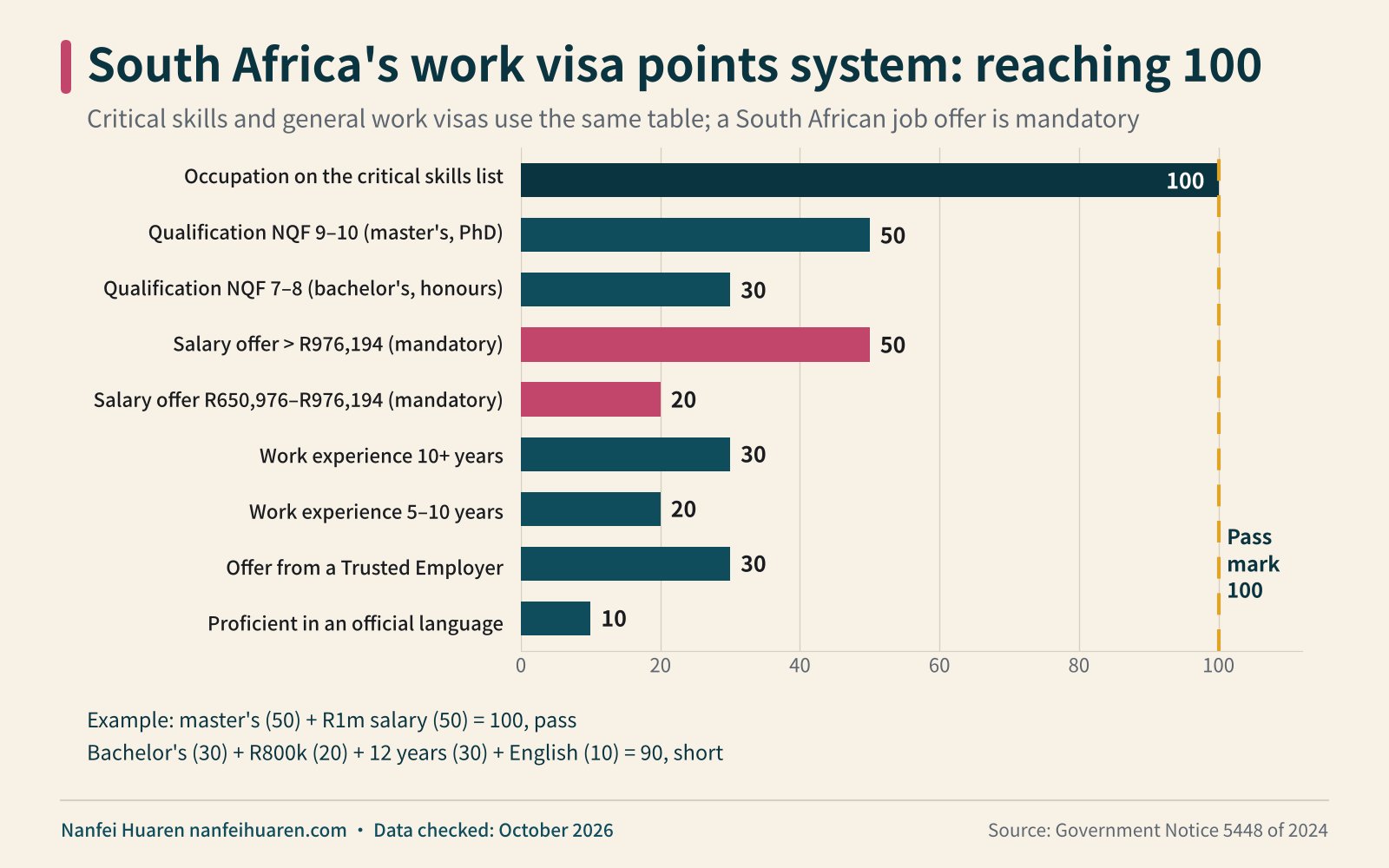
Under Government Notice 5448 of 2024, both the general and critical skills work visas use the same table, and a job offer from a South African employer is mandatory:
| Criterion | Condition | Points |
|---|---|---|
| Occupation | On the critical skills list | 100 |
| Qualification | NQF 9–10 (master’s, doctorate) | 50 |
| Qualification | NQF 7–8 (bachelor’s, honours) | 30 |
| Job offer salary (mandatory) | Above R976,194 gross a year | 50 |
| Job offer salary (mandatory) | R650,976–R976,194 gross a year | 20 |
| Work experience | 5–10 years | 20 |
| Work experience | 10+ years | 30 |
| Employer status | Offer from a Trusted Employer | 30 |
| Language | Proficient in at least one official language (e.g. English) | 10 |
Example: a master’s degree (50) plus a R1 million salary (50) gives 100 points and a general work visa. A bachelor’s degree (30) plus R800,000 (20), 12 years’ experience (30) and English (10) gives 90, which falls short. An offer from a Trusted Employer would add 30 and clear the bar. Reaching 100 through a critical skills occupation leads to a critical skills work visa; any other combination leads to a general work visa. Police clearance, medical reports and the other documents are still required.
Phase II of the Trusted Employer Scheme took applications from 20 July to 4 September 2026 for infrastructure projects and regional or global head offices, among others. Employees of accepted companies get priority processing, fewer documents and an automatic 30 points.
The critical skills list
As of October 2026 the list gazetted in 2022 is still in use. It covers engineering (civil, mechanical, electrical, mining, chemical and more), ICT, health professions, the built environment, business and economics (for example actuaries) and academics and researchers. A critical skills application also needs:
- a SAQA (South African Qualifications Authority) evaluation of your qualification. If the result is pending, you can get a one-year visa on proof of your SAQA application and extend it to the full term once the result arrives;
- confirmation of your skills and experience from the relevant professional body (for example ECSA for engineers, HPCSA for doctors), with proof of registration application where the law requires it (senior university lecturers excepted).
Documents: tips for Chinese applicants
- DHA-1738 long-term visa form, points form, and passport valid 30+ days after departure with at least two blank visa pages, plus a copy of the data page;
- Job offer or contract signed by the South African employer, with a salary matching your points claim;
- Degree certificates and the SAQA evaluation;
- Police clearance: apply to the public security bureau where your hukou is registered or where you live, then have it notarised. China has applied the Apostille Convention since November 2023, so an apostille can be added; follow the visa centre’s checklist;
- Original medical certificate in the Home Affairs format. The Beijing district also asks for the red International Travel Health Certificate. Both must show your name and passport number;
- English translations of all Chinese documents. The Shanghai district also wants an Affidavit of Physical Presence in China, an entry/exit record with a verification number, and a copy of your ID card.
Fees: as of October 2026 the government work visa fee is R1,520. The VFS China page lists a visa fee of RMB 616 plus a RMB 343 service fee; pay what applies on the day. Processing usually takes about eight weeks from the day after submission.
Common mistakes
- Starting work on a tourist or business visa or an ETA while “waiting for the work visa”. In July 2026 the Chinese Embassy warned that illegal work can lead to fines, prison, deportation and entry bans, and employers are liable too.
- Changing employer or role without updating the visa. The visa is tied to a specific employer and position.
- Leaving renewals to the last minute. Renewals can be lodged in South Africa through VFS; allow plenty of time.
For job channels see finding a job in South Africa, and for contracts, pay and dismissal rules see South African labour law.
FAQ
Can I go to South Africa to look for work first?
Not on a work visa. The points system requires a job offer first, and the critical skills visa is not a job-seeker visa.
Can my family come with me?
Your spouse and children can apply for accompanying visitor or study visas, but an accompanying visa does not let your spouse work; they need their own work visa.
Do I pay tax in South Africa on a work visa?
Income from work in South Africa is generally taxable there. Tax residence rules are in our South African income tax guide.
When can I apply for permanent residence?
After five years on a work visa with a permanent job offer, you can apply. Critical skills holders have a separate route. See permanent residence and the visa section.
Sources
- Immigration Act, 2002: Points-Based System, GN 5448 of 2024 (Laws.Africa / lawlibrary.org.za)
- DHA: Types of visas – work, critical skills, intra-company transfer and corporate visas
- Government Gazette No. 55209, GN R.7834: First Amendment of the Regulations on Fees (17 Aug 2026)
- VFS Global: South Africa visa information in China (English)
- VFS Global: South Africa visa information in China (中文)
- 中国驻南非使馆提醒中方人员及机构遵守签证法规、合法用工(光明网,2026年7月30日)
- Cliffe Dekker Hofmeyr: The Trusted Employer Scheme re-opens for Phase II (21 Jul 2026)
- Intergate: South Africa Critical Skills List 2026