
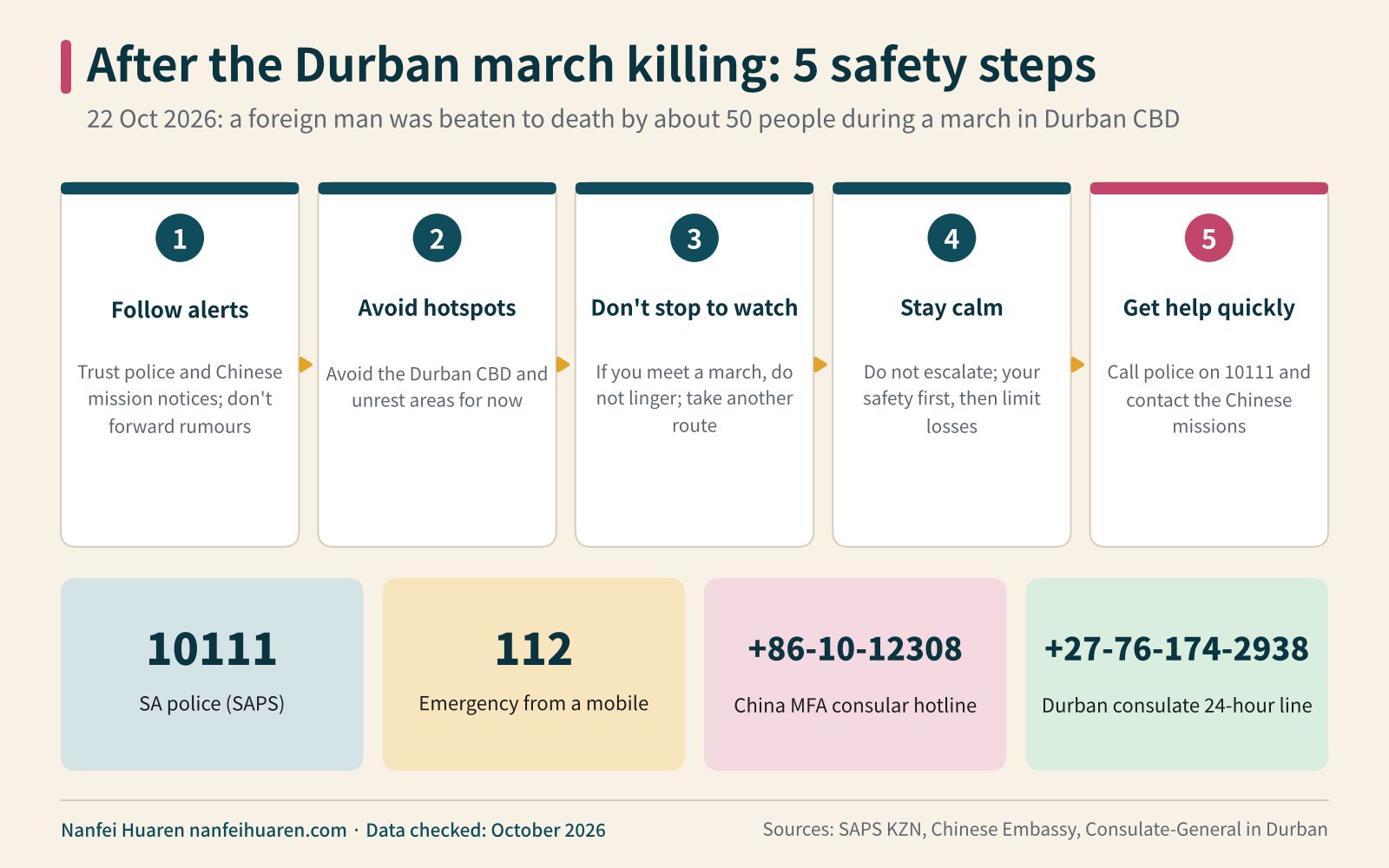
On Thursday 22 October a foreign national was beaten to death by a group of about 50 people at the roadside during a march through Durban’s city centre. KwaZulu-Natal police have opened a murder case; they have not named the man’s nationality, and no arrests had been reported. The safety alerts the Chinese Embassy and Consulate-General in Durban issued in early October still apply: stay away from Durban CBD and other areas with unrest, don’t stop to watch marches, and call the police and the Chinese missions if something happens.
What happened, according to police
KwaZulu-Natal police spokesperson Colonel Robert Netshiunda told Business Day that a group was marching along Dr Pixley kaSeme Street towards Maud Mfusi Street when two men broke away and approached a man standing at the roadside. He was then assaulted by about 50 people and declared dead at the scene. Police describe him as a foreign national in his late 30s or early 40s. A murder case has been opened and police say they are “following several leads” to identify suspects.
Police also urged the public not to spread unverified information. As of the reports on 22 October, police had not released the victim’s nationality, who organised the march or any arrests, and the motive was not yet established.
The same Business Day report says that on Thursday morning protesters carrying sticks allegedly tried to force their way into a visa and permit office in Morningside, Durban, and dispersed when police and private security arrived. That account comes from the private security company; police have not issued a separate statement. If you need to visit a visa or permit office in Durban soon, check that it is open before you go.
Background: anti-immigrant marches since early October
According to the Chinese Embassy’s alert of 10 October, anti-illegal-immigration groups marched in Durban’s city centre and in Soweto on 8 October to protest against foreign nationals applying for refugee status, and clashes, looting, vandalism and car burning aimed at migrants and foreign-owned shops followed. The Consulate-General in Durban issued its own alert on 9 October asking Chinese citizens in KwaZulu-Natal to avoid Durban CBD for now. We covered both alerts in our report of 16 October.
AP reports that President Ramaphosa has condemned violence against migrants, while South African authorities have disputed some foreign governments’ claims about deaths, saying some were linked to ordinary crime. With the 4 November local government elections less than two weeks away, keep an eye on police and Chinese mission notices in the run-up to and after the vote.
What Chinese residents should do now
The missions’ advice comes down to: stay away, don’t watch, stay calm, get help. For shop owners and people on the road for work, that means:
- Check before you travel: rely on the police, the Chinese missions and established media. Verify WeChat videos and “march tomorrow” messages before forwarding them; police have specifically asked people not to spread unverified information.
- Avoid Durban CBD for now: don’t go into the CBD or areas that have seen unrest unless you must; if you have to, avoid march times, use routes you know and keep valuables out of sight in the car.
- If you meet a march: don’t stop, film or watch; turn away. In a car, keep the doors locked and keep your distance from crowds.
- Protect your shop: if you get reliable word of a march nearby, consider closing early and keeping less cash on site. Move staff to safety first; people matter more than stock, and never confront a crowd.
- Keep records: after reporting to police, note the case number and keep photos and CCTV footage for insurance claims and consular help.
Emergency numbers
| For | Number |
|---|---|
| Police (SAPS) | 10111 |
| Emergency from a mobile | 112 |
| Ambulance (public) | 10177 (the embassy notice also lists 999 or 082 911) |
| China MFA Global Consular Protection and Services hotline | +86-10-12308 or +86-10-65612308 |
| Chinese Embassy, consular protection | +27-10-492-5583 |
| Consulate-General in Johannesburg | +27-10-498-6234 |
| Consulate-General in Cape Town | +27-21-674-7668 |
| Consulate-General in Durban (24 hours) | +27-76-174-2938 |
| KwaZulu-Natal Chinese police–community centre | +27-65-311-0110 |
These numbers come from the Chinese Embassy’s notice of 10 October and the Durban Consulate-General’s notice of 9 October (as of October 2026). For more detail see emergency numbers and what to do in an emergency and Chinese Embassy and consulates in South Africa; for everyday precautions see our South Africa safety guide, and for life in the city see the Durban city page.
FAQ
Was the victim a Chinese citizen?
Police have only said he was a foreign national and have not given his nationality. As of 22 October the Chinese missions in South Africa had not announced any Chinese casualties. If you cannot reach a relative or friend in Durban, call the Consulate-General’s 24-hour line on +27-76-174-2938.
Is the rest of Durban safe?
The missions’ alerts concern Durban CBD and other areas with unrest; they do not ask people to leave Durban. Daily life goes on, but avoid the city centre and march routes for now and follow local news.
What should I do if my shop is looted or damaged?
Make sure everyone is safe, call the police on 10111, note the case number and keep CCTV and photos. You can also contact the local Chinese police–community centre and the Chinese missions for help.
Should I forward videos from the scene in WeChat groups?
Better not. Police have asked people not to spread unverified information, and unsourced videos or “march alerts” can cause needless panic. Check before you share.
Sources
- Chinese Embassy in South Africa: safety alert for Chinese citizens (10 October 2026, in Chinese)
- Chinese Consulate-General in Durban: safety alert (9 October 2026, in Chinese)
- U.S. Embassy Pretoria: Security Alert (9 October 2026)
- Business Day: Murder case opened after foreign national killed in Durban attack (22 October 2026)
- AP via ABC News: Foreign citizen beaten to death during march in South Africa (22 October 2026)
- Al Jazeera: Foreign national beaten to death by a mob in South Africa (22 October 2026)